
SYSTEMIC BLACKOUT: Report exposes collapse of District accountability
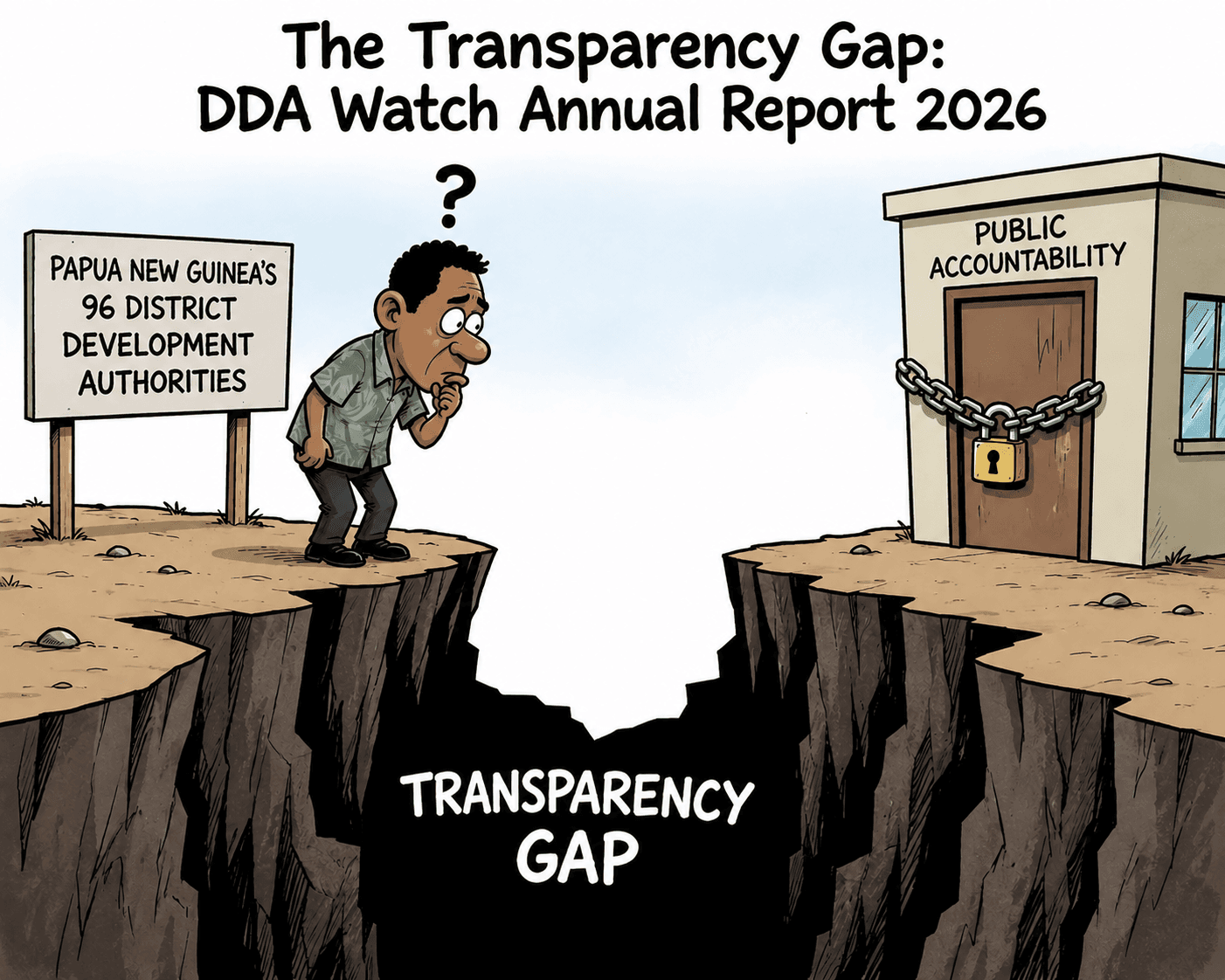
With less than 12 months remaining before the 2027 National Elections, Papua New Guinea is facing a catastrophic breakdown in institutional integrity.
The 2026 DDA Watch Report, released today by ACT NOW!, is based on an analysis of data published on our DDA Watch website.
The analysis reveals that four years into the current parliamentary term, transparency among the nation’s 96 District Development Authorities (DDAs) has hit a terminal low.
Despite the annual allocation of K20 million per district—representing a staggering K2 billion in public wealth managed at the local level this year alone—the national average transparency score has stalled at a dismal 18 out of 100.
This is not merely a failure of administration; it is a systemic blackout.
As incumbent MPs prepare to ask for another mandate, most districts are operating in total secrecy, effectively disenfranchising millions of citizens by withholding the most basic evidence of how their money is spent.
In any functional democracy, access to information is the non-negotiable prerequisite for accountability. Without public plans, budgets, and acquittals, "social auditing" is impossible, and the public is left to guess whether their resources are being invested or stolen.
Despite being 80% of the way through the 2022–2027 planning and implementation cycle, the disconnect between statutory requirements and reality is absolute. The following table summarizes a near-total collapse of open governance:
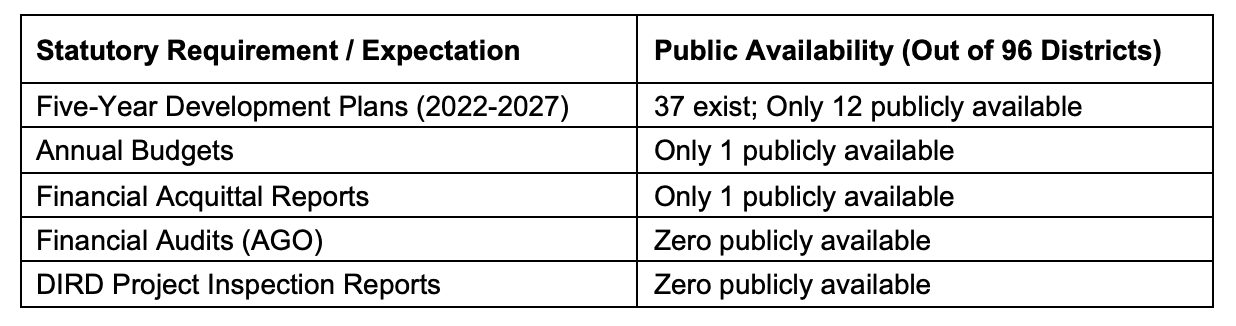
The fact that only 12 districts have made their five-year plans public four years into the cycle means that billions are being spent on projects that have never been verified against community needs. This is a systemic disenfranchisement of the rural majority.
The absence of public audits creates a high-risk environment where public funds are essentially unmonitored. This "black hole" is a direct result of the lack of capacity of the state’s primary oversight bodies: the Department of Implementation and Rural Development (DIRD) and the Auditor General’s Office (AGO).
Between 2017 and 2025, the AGO conducted only six audits of Service Improvement Program (SIP) funds across nearly 500 eligible institutions. DIRD has fared no better. Despite ACT NOW!’s repeated formal requests, DIRD has failed to produce a single project inspection report.
In a previous monitoring cycle, DIRD’s team reportedly visited only 3 provinces and 16 districts—a negligible effort that highlights a total lack of widespread oversight.
This institutional failure ensures that while K20 million flows into each district annually, there is no verified proof that the promised health centers, schools, or roads really exist.
The 2026 report data reveals a grim reality: there is no statistical difference in performance across the country. The average DDA score in every region ranges from a measly 16 to 18 out of 100, based on the transparency and accountability criteria on the website. This shows that opacity is a national condition.
- Regional Outliers: West New Britain (35) and Western Province (33) remain the "best" performers, though both are failing the 50-point transparency benchmark. At the bottom, Milne Bay (5), East New Britain (8), and Hela (8) represent absolute "zones of silence."
- The Media Illusion: In the Highlands and Momase regions, high-profile districts like Wabag and Bulolo dominate news cycles. However, the report reveals a "Media Gap": high news coverage is not translating into document transparency. In these districts, ribbon-cutting ceremonies and social media posts are being substituted for statutory transparency. Political optics are masking a continued refusal to publish the actual plans and budgets that would allow for true accountability.
These failures are not merely administrative—they are a direct result of a policy environment that rewards silence with continued funding.
The time for polite recommendations has passed. To save the DDA system from total collapse, ACT NOW! is urging the immediate implementation of the following reforms:
- Department of Finance: The immediate halting of all DSIP and DIP funding to any district that fails to provide five-year plans, annual acquittals, or basic contact details. Public funds must never be a "blank check" for secretive administrations.
- Ombudsman Commission: Immediate action under the Leadership Code to investigate negligent DDA CEOs and Board Chairs who have failed their statutory obligations to publish financial and planning documents and acquittal reports.
We urge every citizen to visit the DDA Watch website to use the "social auditing" tools available and to make their voice heard.
The DDA Watch score for each district includes 30 points based on public satisfaction voting. By rating your local DDA, you are participating in the only active oversight mechanism currently functioning in the country.
It is time to demand the 'gutpela sindaun' we are promised every five years by sitting MPs and aspiring candiadates.