
Fifty years on, PNG’s founding economic promise remains unmet
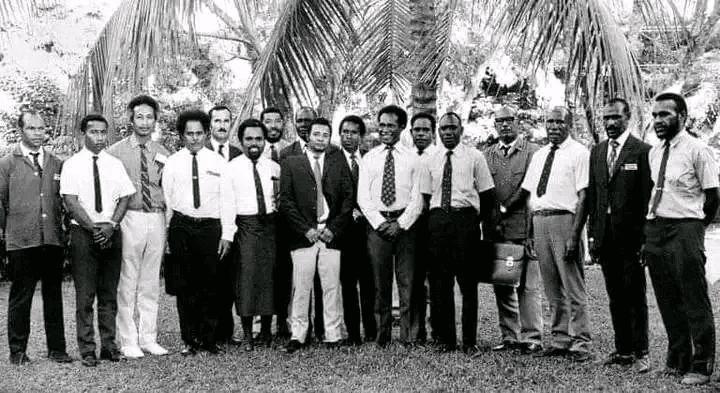
In 1972, as Papua New Guinea prepared for self-government, its first Chief Minister Michael Somare tabled a document that would become the moral compass of the new state’s economic policy. The Eight Point Plan promised something rare among newly independent states: development on Papua New Guinea’s own terms, driven by its own people rather than dictated by foreign capital. It called for local ownership of the economy, equal distribution of services between town and village, decentralised government, support for small Papua New Guinean businesses, a self-reliant economy less dependent on imports, a domestic tax base big enough to fund the state, and, striking for 1972, equal participation of women in economic life.
Fifty-plus years later, that plan’s language is still everywhere in PNG’s official planning. It was folded into the National Goals and Directive Principles of the 1975 Constitution. It reappears, restated rather than revised, in the Vision 2050 strategy, the PNG Development Strategic Plan 2010–2030, and in each of the four Medium Term Development Plans that followed, the latest of which promises to grow the economy to 200 billion kina by 2030 and create a million new jobs.
The persistence of the plan is itself telling. No PNG government, whatever its politics, has felt able to discard it. But repetition is not delivery, and on the plan’s own terms the country remains far closer to where it started in 1972 than to where its founders hoped it would be by now.
PNG’s economy is still built around extractive industries, oil, gas, copper, gold, timber, that are capital-intensive, largely foreign-financed, and generate comparatively few jobs for the roughly 80 percent of Papua New Guineans who live outside the major towns. Decentralisation, the point the country has pursued most consistently on paper, has in practice meant shifting funding and responsibility to provinces and districts faster than the administrative capacity to use it well. And on the plan’s seventh point, equal participation of women, the gap between promise and reality is starkest of all: PNG ranks among the world’s lowest countries on UN gender equality measures, with only a handful of womenin a national parliament of more than a hundred seats.
None of this means PNG has failed to plan. If anything, its planning architecture has become more sophisticated with each decade, coupling ambitious targets to costed sector strategies and, in the current Medium Term Development Plan, to explicit provincial service standards. What has not kept pace is the discipline of checking those targets against outcomes and being honest in public about the gap. Reliable, independently verifiable data on service delivery, informal-sector employment and gender outcomes at the district level remains thin, a problem PNG’s own planning department and UN agencies openly acknowledge.
That accountability gap matters well beyond PNG’s borders. As the largest and most resource-rich state in the Pacific Islands, PNG’s economic trajectory shapes the strategic environment Australia and its partners operate in. A country that keeps promising self-reliance while its revenue base stays exposed to volatile resource royalties, and its rural majority stays under-served, is more exposed to external economic leverage, whether from resource-hungry investors or geopolitical competitors offering finance with fewer strings attached. Weak service delivery and entrenched inequality are also the conditions in which local grievance, corruption and instability tend to fester, as PNG’s own recent history of urban unrest suggests.
The fix is not another rebranded plan; PNG has enough of those. What would genuinely change the trajectory is a credible, independent mechanism, inside or outside government, that publishes, plan by plan, whether the specific targets set five years earlier were actually met, and why not when they weren’t. Australia and other development partners, who already fund large parts of PNG’s service delivery and statistical capacity, are well placed to back exactly this kind of monitoring rather than yet another glossy strategy document.
PNG’s fiftieth-anniversary reflections rightly celebrate what the country has achieved since 1975: a durable democracy, unbroken by coup or dictatorship, in one of the world’s most linguistically and geographically fragmented states. That achievement deserves equal candour about the economic promises still unmet. The Eight Point Plan was never wrong in its aims. What Papua New Guinea has lacked is not vision, but the accountability to match it.
Originally published https://aunamelo.wordpress.com/2026/07/10/fifty-years-on-pngs-founding-economic-promise-remains-unmet/