
New reports add to mounting evidence Forest Authority failing to keep logging industry in check
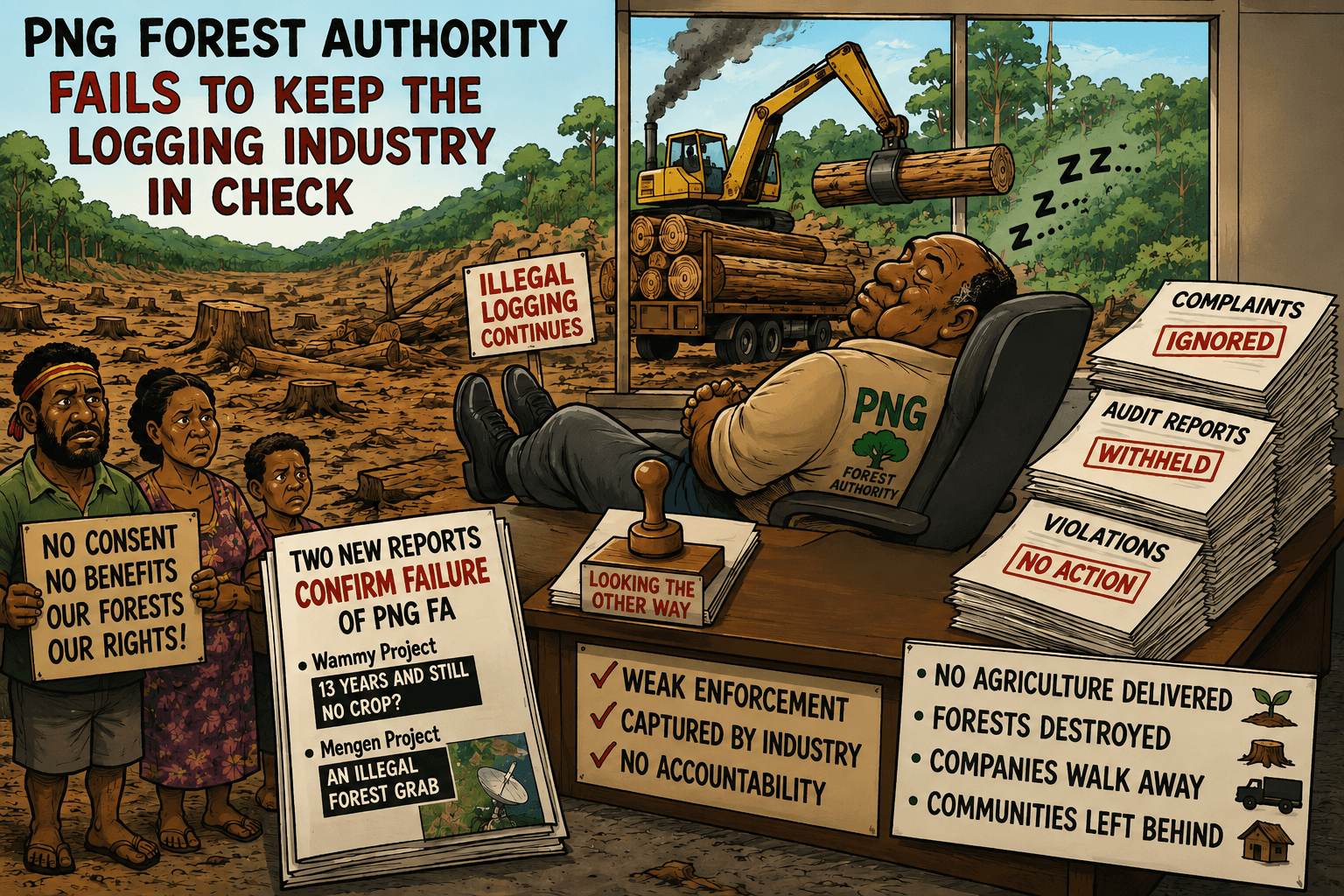
Two new reports highlight the failure of Papua New Guinea’s Forest Authority to properly manage and regulate the commercial logging industry.
Fundamental reform is essential if government policy goals are to be realised, the livelihoods of rural communities protected and PNGs rich biodiversity preserved. These reforms should start with a new Forestry Act and a new government agency to administer the sector
The new report findings reinforce the conclusions published earlier this year by a Special Parliamentary Committee that found the Forest Authority has been captured by foreign logging companies and is failing PNG’s forest resource owners.
The Committee reported “weak legislative enforcement, possible systemic corruption, and a fundamental lack of will to prosecute offenders” and accused the Forest Authority of a “dereliction of duty” and “willful negligence” in shielding logging companies from penalties and licence cancellations.
These findings are graphically illustrated in the two new reports which use analysis of satellite imagery to examine what has happened in two controversial Forest Clearing Authority logging projects since they were exposed as a cover for large-scale selective logging in 2023.
The reports find that logging operations were allowed to continue in the two projects despite clear evidence that the logging companies were not delivering promised agricultural projects and were conducting illegal selective logging operations.
In one case, the logging company has now left the project area, having exhausted all the accessible forest areas and in the other the company is continuing to flout its permit conditions.
In neither project, however, is there any evidence that PNG Forest Authority has acted on the significant concerns highlighted in earlier reports published in 2023.
Thirteen Years and Still No Crop? is an update report on the Wammy Rural Development Project in East Sepik. The report reveals that despite thirteen years of commercial logging, the logging company has only established 336 hectares of promised oil palm plantation, covering less than 0.3% of the total concession area. Meanwhile, the company has exported round logs with a declared value of over K170 million.
Findings from the earlier September 2023 report Ten Years Without a Crop, found that the logging bore all the hallmarks of an unlawful large-scale selective logging operation with only minimal agricultural planting. There was also, strong evidence of a lack of consent from many local people, and violence against those who protested the logging.
The second new report, An Illegal Forest Grab, is an investigation of the Mengen Integrated Agriculture Project in East New Britain.
The report finds that despite clear evidence published in 2023 that the logging company had failed to establish any promised agriculture projects and was instead operating a large-scale log export project, the logging was allowed to continue until all the accessible areas of forest had been exhausted. The logging company then packed up and left with no compensation for the local resource owners and no sanctions preventing it from logging in other areas in the future.
The new report findings are even more astounding given the 2023 National Forest Board imposed moratorium on new FCA licences and order to audit existing projects.
The National Forest Board acknowledged the controversy over the abuse of FCA logging permits at the beginning of 2023, but there is no evidence that any projects have been shut down. There is also no evidence of any sanctions against any of the companies involved, and the Forest Authority is refusing to release any of the audit reports.
This is a government agency that is not operating to protect the interests of customary resource owners or promote the national interest.