
Hollow victory for Wanigela villagers fighting destructive foreign logging
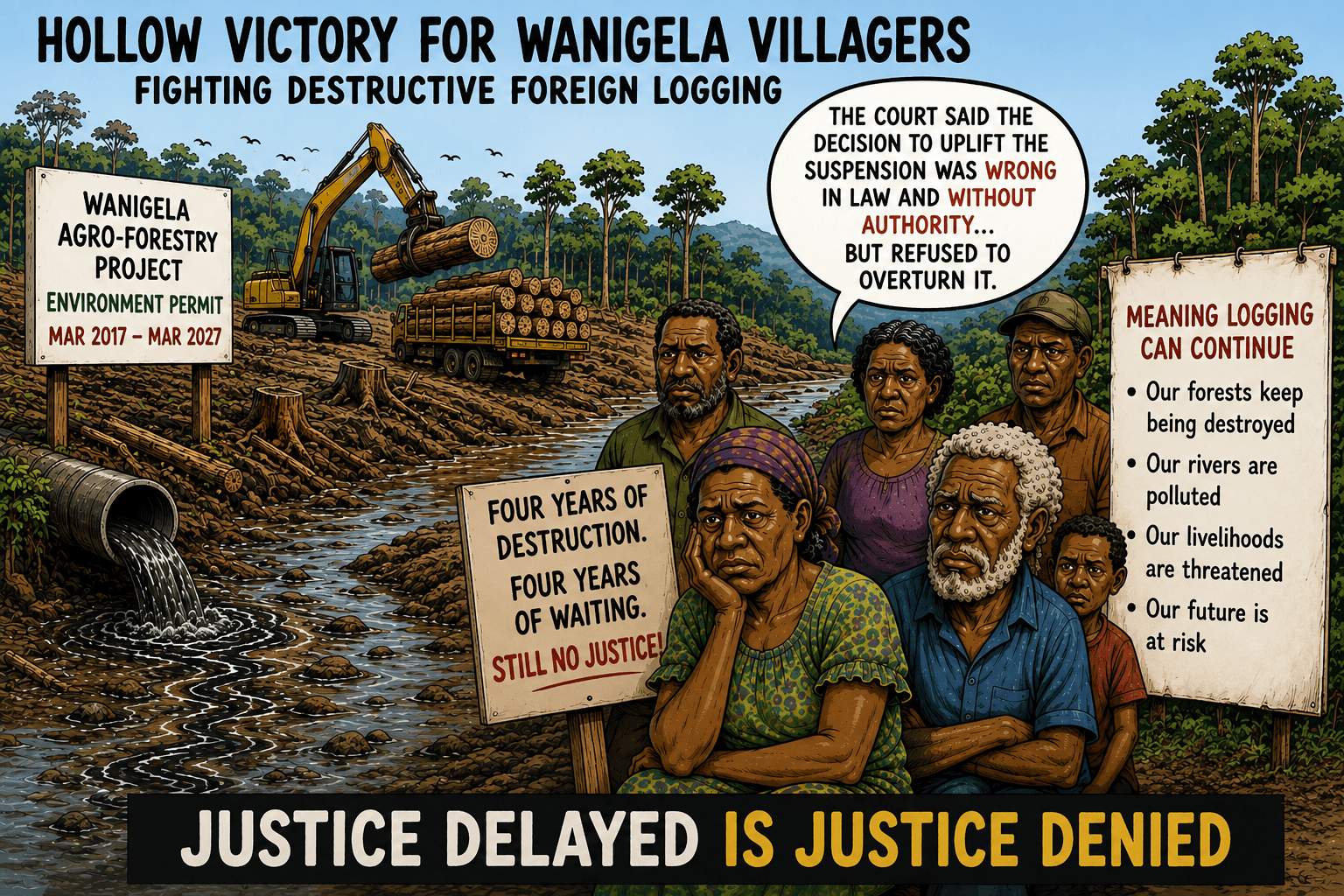
A decision by the Environment Council in 2022 to uplift the suspension of an environment permit allowing logging operations under the Wanigela Agro-Forestry project was both wrong in law and made without lawful authority according to a recent National Court decision.
But in a bitter sweet decision for local communities, the court has refused to reverse the decision to uplift the suspension, which means logging operations can continue for at least another 8 months until the expiry of the permit.
This is despite claims by the customary resource owners from Wanigela village in Oro Province who brought the legal action, that the logging is causing ongoing destruction of their forests and pollution to the river systems and water sources that they rely on for their daily survival.
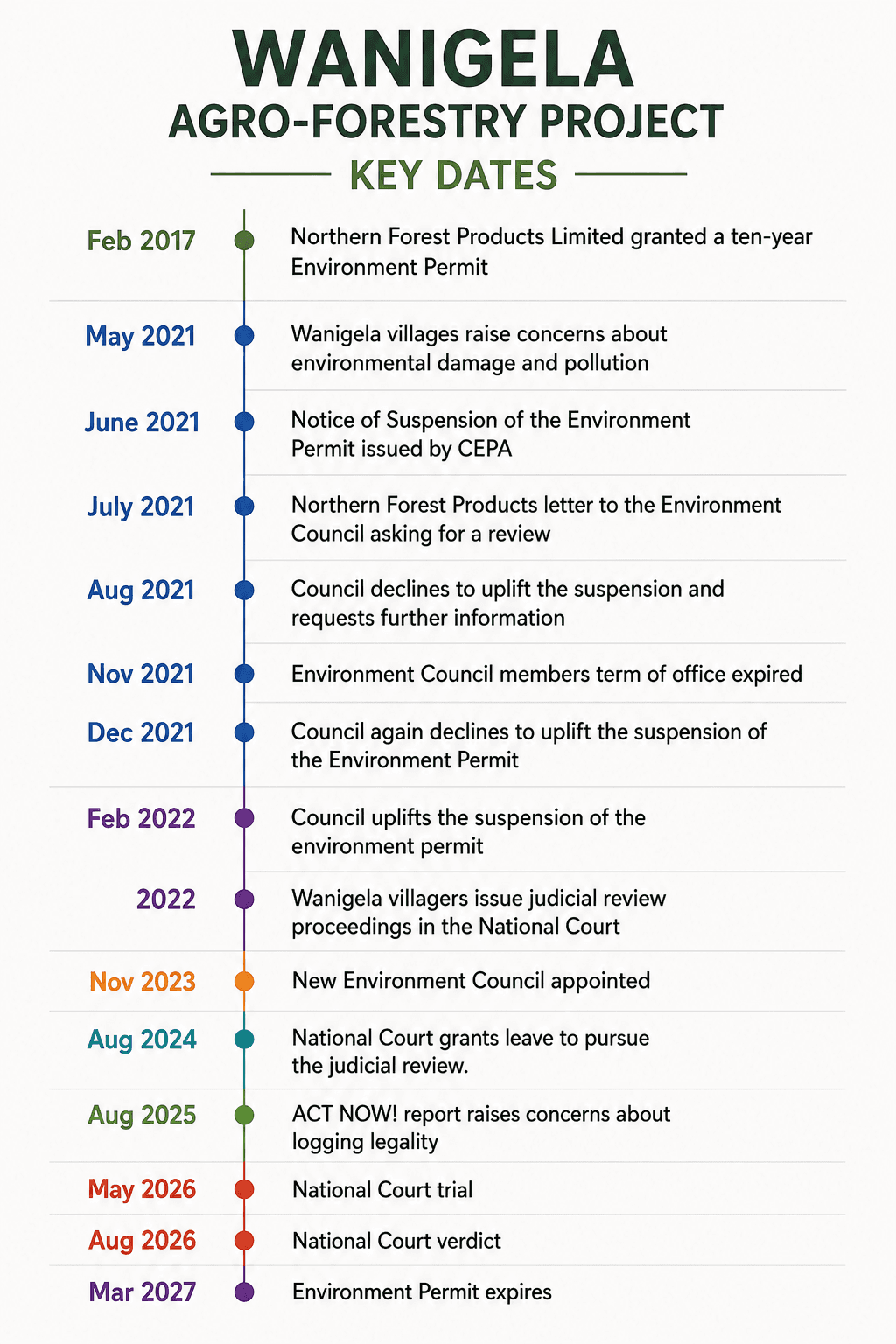
The Malaysian logging company, Northern Forest Resources was granted a ten-year Environmental Permit for the Wanigela Agro-Forestry Project in February 2017.
Since then, Northern Forest Products logging operations “have caused ongoing destructions and pollution to the river systems and water sources that the Plaintiffs rely on for daily survival”.
In May 2021, the resource owners raised their concerns in a letter to the Minister for Conservation and Environment Protection and to their Governor, requesting action to address the environmental damage caused by logging.
On 30 June 2021, a Notice of Suspension of their Environment Permit was issued to Northern Forest Products by the Chair of the Environment Council.
The suspension was based on two grounds. These were ‘misleading and false information’ submitted in the permit application and the environmental destruction and pollution complaints raised by the Wanigela villagers.
On 19 July, Northern Forest Products wrote a letter to the Environment Council asking for a review of the suspension decision.
On 12 August, the Council convened a meeting to discuss the review application. In that meeting the Council declined to uplift the suspension and requested the logging company provide further information and documents.
On 24 August, Northern Forest Products did submit some further information but in a subsequent meeting on 1 December, the Council again declined to uplift the suspension of the environment permit, citing insufficient information and non-compliance with permit conditions.
Around the same time, the Environment Council members term of office expired, and a new Council was not appointed until 9 November 2023.
In the meantime, on 18 February 2022, the Council issued a decision uplifting the suspension. The decision stated the Council was satisfied with the information provided and that it met the conditions of the permit and had rectified the non-compliance issues raised by the villagers.
The community though were enraged by the decision. They issued judicial review proceedings in the National Court claiming the logging company had not followed proper process in lodging its appeal, the Council term having expired, it had no authority to lift the suspension.
Almost two years later, in August 2024 the National Court granted the resource owners leave to pursue their judicial review.
It then took a further two years, until May 2026, for the case to be heard. Finally, on 14 August, the court’s verdict was delivered.
The court found that the decision to uplift the suspension of the environment permit was wrong in law and outside the powers of the Council.
The court was satisfied the logging company failed to use the correct legal procedure in applying for a review of the initial suspension. It did not submit the correct form and relied instead on an informal letter, in breach of the provisions of the Environment Act and Regulations.
In addition, as terms of the Environment Council members expired in November 2021 and a new Council was not appointed until November 2023, there was no legally constituted Council when the suspension of the environment permit was uplifted. The Council lacked any statutory authority to make its decision and therefore the decision was unlawful.
In a painful twist though for the Wanigela villagers, despite finding the decision to uplift the suspension was wrong in law and outside the powers of the Council and therefore unlawful, the court refused to overturn the decision.
The reason given was that overturning the decision would “cause unnecessary inconvenience” and “be detrimental to good administration”.
In making this decision the court relied on the facts that the original decision of the Council was made more than four years earlier, that the environment permit is due to expire in March 2027 and that the Council had been satisfied the environmental and compliance issues raised by the plaintiffs had been resolved.
No matter that the local resource owners have suffered a further four-years of logging since the unlawful decision was made and allege that the same environmental damage and pollution is ongoing.
The resource owners were represented in court by the Centre for Environmental Law and Community Rignts Inc.
Justice delayed is justice denied
Environmental justice must be accessible, timely, and responsive to be effective.
This was the message delivered by Australian barrister Robert White at the recent Lawasia Environmental Law Conference held at APEC Haus in Port Moresby.
White, who is also the Vice-President of the Environment and Planning Law Association of New South Wales, warned that delays or barriers in law can make environmental harm irreversible and ‘rights without remedies can remain aspirational’.
It is a message that the Wanigela community would undoubtedly endorse although for them it provides little comfort.
They had to endure a four-year wait between the decision of the Environment Council to uplift the suspension of the Environmental Permit that allowed logging in their forests to recommence and a court ruling that the decision was unlawful.
In the meantime, Northern Forest Products could continue its environmentally destructive logging practices.
To add further insult to the resource owners, despite winning the legal argument the court has ruled the logging can continue for at least another 7 months until March 2027.
Serious doubts over logging legality
In August 2025, community advocacy organisation ACT NOW! and Jubilee Australia Research Centre published a report that seriously questions the legality of the whole Wanigela logging operation,
FCA Case Study #4 details how the logging has been allowed to proceed despite strong local opposition, evidence the Forest Clearing Authority (FCA) logging licence is not being used for forest clearance and agriculture, and concerns over legal compliance.
The FCA was issued for a supposed tree plantation project that involves chopping down tropical rainforest across approximately 42,600 hectares.
Yet, eight years after logging started, there is no evidence of a tree plantation being established, confirming serious concerns that the agricultural project was a pretext for selective large-scale native forest logging.
This is supported by satellite image analysis that shows no clearing of land for agricultural purposes - indicating that the FCA’s terms are not being met - and considerable logging outside the FCA boundaries.
By the end of 2023, 150,000 cubic metres of round logs had already been shipped from the area, with a declared value of around USD 15 million (PGK 60 million).
The report also highlights persistent community opposition to the logging, alongside ongoing concerns about resource owner consent and the project’s environmental and social impacts - concerns that remain unaddressed.