
US government says logging industry in PNG heavily implicated in people trafficking
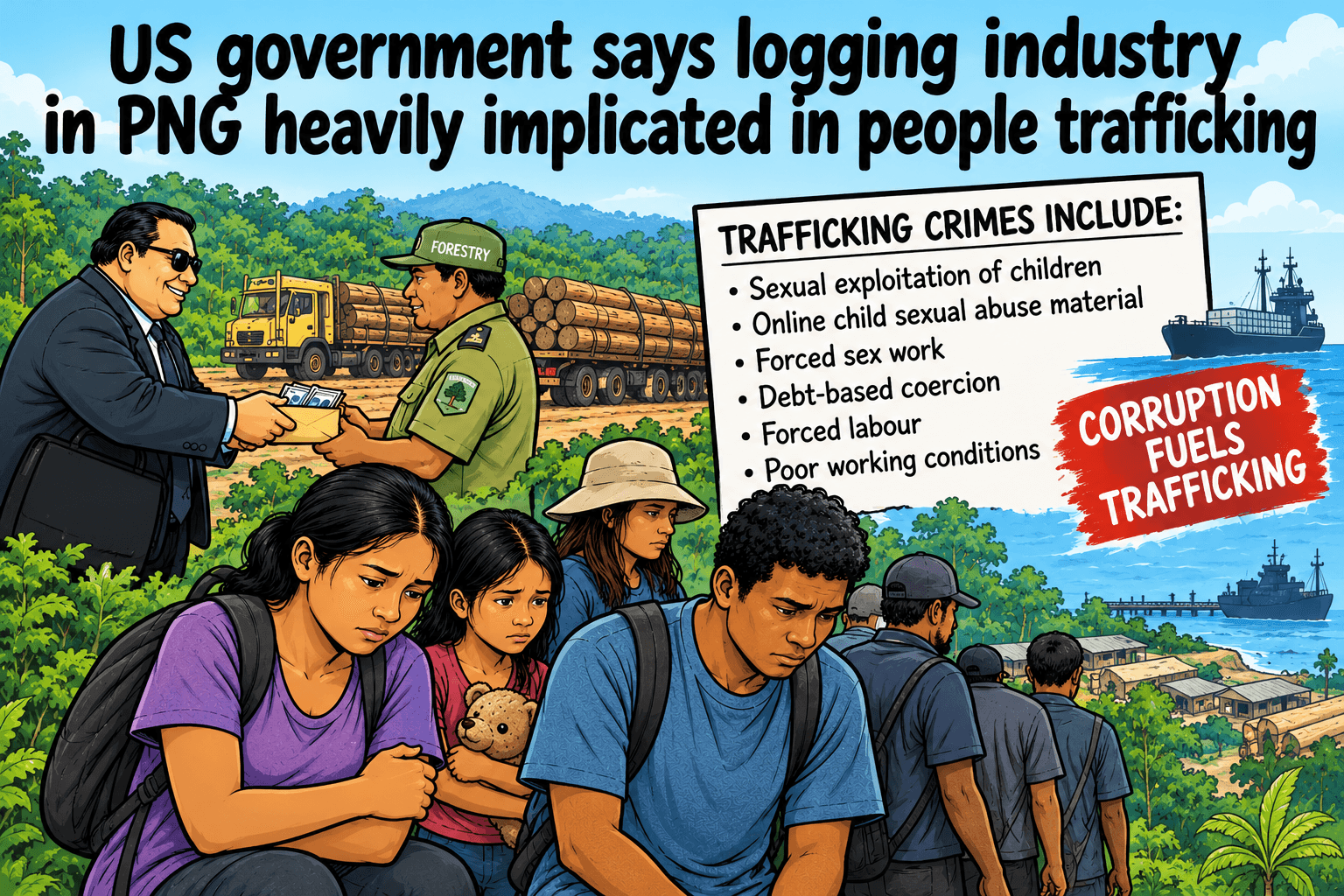
A United States government report says human trafficking of both foreign nationals and local people is prevalent in many forms in the logging industry in Papua New Guinea but endemic corruption means the government is making minimal events to prevent it.
“Corruption among forestry officials may facilitate forced labor and sex trafficking; some officials accept bribes to issue logging permits in violation of standards, leading to displacement of communities. Logging companies bribe officials to bypass inspections and not take law enforcement action against employees accused of crimes, including trafficking.”
According to the US Department of State annual Trafficking in Persons Report for 2026, trafficking victims in the logging industry include children, women and men.
Trafficking crimes identified include the sexual exploitation of children and production of online child sexual abuse material in logging camps, trafficking of women who are forced into sex work, debt-based coercion among foreign workers, forced labour and poor working conditions.
Malaysian and China-based logging companies are singled out for arranging for foreign women to enter PNG with fraudulent issued visas, some of whom end up working in other sectors of the economy:
“... after arrival, many women – from China, Fiji, Indonesia, Malaysia, the Philippines, and Thailand – are turned over to traffickers who exploit them in sex trafficking and domestic servitude at logging and mining camps, fisheries, and entertainment sites.”
Log ships are also identified as route for trafficking victims to enter PNG with customs officials reporting a lack of manpower, monitoring and surveillance equipment, and funding as impairing anti-trafficking efforts for labor or sex trafficking on ships in PNG waters.
Corruption is also leading to law enforcement officials accepting bribes from incoming vessels and logging companies, which greatly hindered anti-trafficking efforts in those industries, according to the report.
Despite screening more than 200 foreign nationals detained for working illegally in the logging and mining sectors over the past twelve months, the report says the PNG government failed to identify any cases of trafficking. As a result there have been no prosecutions for more than four years.
There was also no action taken against companies responsible for fraudulent recruitment practices or work visa abuses.
Failures in law enforcement are attributed to corruption in government agencies, with evidence of official complicity in trafficking crimes.
“Law enforcement agencies and most government offices remained weak as a result of underfunding, corruption, cronyism, lack of accountability, lack of human resources, and a patronage-based promotion system — limiting the government’s ability to investigate and prosecute trafficking crimes”.
Inadequate resources and endemic corruption are also blamed for a lack of adequate steps to prevent forced labour in the logging industry. The report says government has failed to follow up on official reports of mistreatment and pay discrepancies among workers in logging camps or take any action against illegal logging sites.
The report also notes concerns that relevant government agencies lack a mandate to investigate potential trafficking crimes in the logging sector. While the criminal code identifies human trafficking as a crime it does not give the department of labor and industrial relations, or the forest authority the mandate to address human trafficking in these sectors.
Meanwhile, observers reported the Royal Papua New Guinea Constabulary (RPNGC) does not prioritize efforts to combat trafficking, and victims can be denied access to justice because of the remoteness of some communities.
Although PNG does have a dedicated national human trafficking committee, the report states it only met twice over the past twelve months and ‘lacks sufficient resources and commitment from the government’.